
Winter storms don’t wait for anyone—and neither should your crews. When your teams are working against the clock to clean parking lots before business hours, every second counts.
What causes bottlenecks in snow and ice management?
Many snow management companies don’t provide training; crews apply deicing material at the wrong time; and the company lacks the proper equipment needed for success.
If your maintenance crews struggle with inefficient processes, wasted materials, and repeated trips back to the same locations, you’ll have angry property managers, unsafe conditions, lost time, and blown budgets.
However, when you invest in the right materials, strategic application methods, and efficient equipment, your crews will clear properties faster, reduce material costs, and eliminate callback visits.
Choose the Right Deicing Materials to Work Faster
The deicing materials you choose determine how quickly crews work and how often they return to the same location.
Rock salt or sodium chloride loses its effectiveness when temperatures drop below 15°F. When temperatures reach 15°F, switch to calcium or magnesium chloride, since they perform better at lower temperatures.
For extreme cold—when temperatures dip below 0°F—use calcium chloride, which can still melt snow and ice when temperatures drop down to -20°F.
Many municipalities require snow management companies to use liquid deicers before a storm because they prevent snow from bonding to the pavement.
Liquid deicers also work faster because they’re already in a solution and you don’t need to wait for the salt to dissolve.
Granular materials work best during and after a storm. They also prevent snow and ice from hardening again.
While you may have the three Rs in place (the right materials, applied under the right conditions at the right time), you still need to apply them with the right spreaders.
Read more: Winter Lawn Services That Keep Your Clients Safe & Protected
Apply Deicing Material Strategically to Reduce Repeat Work
Timing matters as much as the type of material you use in your snow management program. Poor timing leads to wasted materials, multiple returns, and customer dissatisfaction.
Here are four strategies for applying deicing material to reduce repeat work:
- Pre-treatment prevents snow and ice from bonding
Apply liquid deicers 48 hours before the storm to prevent snow and ice from bonding to the pavement. You’ll find that pre-treatment makes it easier to plow as well as reduce the amount of material you use.
- Timing matters for granular materials
Use granular materials closer to the storm event, since rock salt can be blown off the pavement by wind and traffic if it’s applied too early. When you wait until the storm’s approaching, deicing materials stay put and work when you need them.
- Clear the lot first and then treat
Plow the parking lots and shovel the sidewalks before applying deicing materials. It doesn’t make sense to put deicers on snow because they won’t work effectively.
- Monitor pavement temperature.
Use infrared thermometers or pavement sensors to determine when to put down deicers. Crews should focus on pavement temperatures rather than air temperatures.
Remember: Over-application of materials wastes money and creates unsafe walking conditions.
However, under-application means more callbacks and still causes hazardous conditions. Instead, calibrate your winter spreaders using application charts to apply the right material at the correct rate for current conditions.
Learn more: Winter is Coming: How to Buy the Best Salt Spreaders & Equipment
Prep Your Crew & Equipment Before Each Storm
The difference between fast, efficient crews and slow, frustrated teams comes down to the right deicing materials and preparation before the storm arrives.
Team leaders should be familiar with advanced weather forecasts to plan material requirements and crew schedules. Knowing what to expect and when the storm will hit allows your teams to pre-treat surfaces and station equipment at high-priority properties.
Set up a pre-storm checklist, equipping your crews for success:
- Equipment is fueled up and ready to go
- Spreaders are calibrated and tested
- Material inventory is sufficient for forecasted conditions
- Crews know property priorities and application routes
- Communication systems are tested and functional.
Remember: training matters. Train crews on all snow and ice management protocols, including deicing selection, proper application rates, equipment operations, and safety.
Your training should prepare teams to work more efficiently, reduce material waste, and create safer conditions.
When your crews have the right preparation, materials and strategy, they still need winter spreaders that keep pace with them.
Our Winter Spreaders Help Your Crews Deice Faster
While you may have all the proper protocols in place, it doesn’t guarantee success if your equipment slows your crews down or breaks mid-storm.
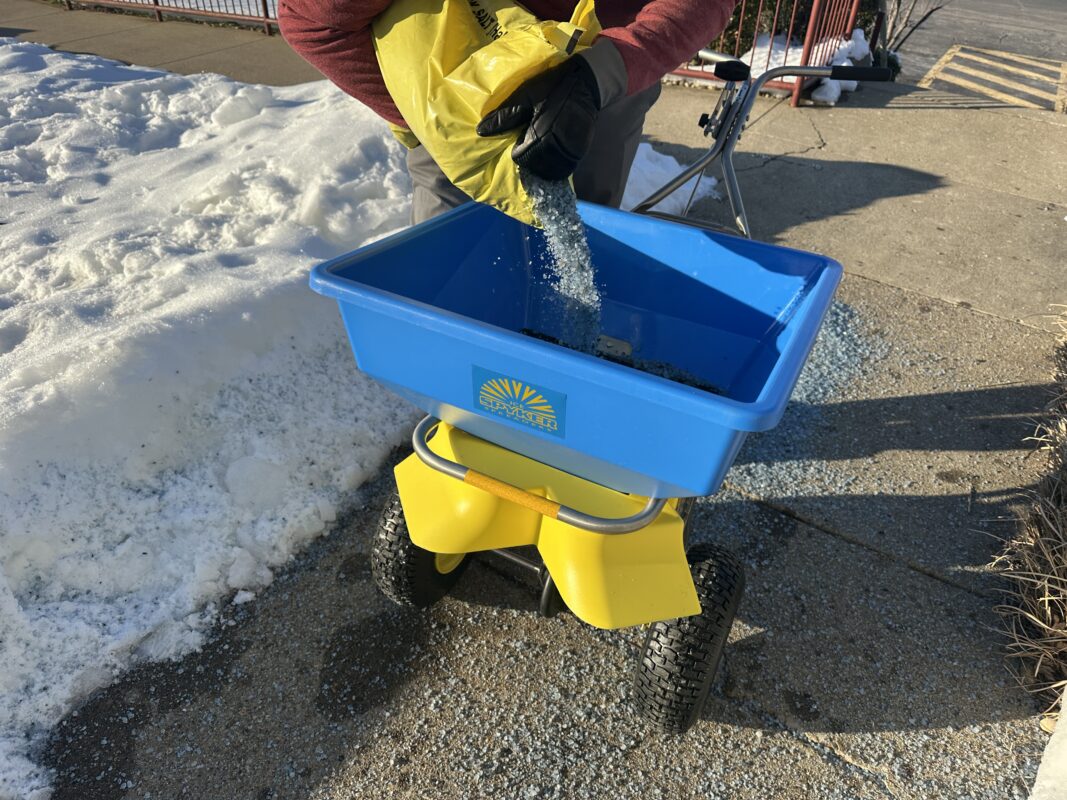
Spyker Spreaders, including our newest addition, the Ergo-Pro 100# Ice Melt Winter Spreader with Variable Deflector, are built to help teams work faster. Our spreaders are designed for even deicing distribution, easy handling, reliable operation, and quick application.
Our spreaders’ key features include
- Pneumatic tires for easy maneuvering
- Large hoppers that reduce refilling
- A precise mechanism for accurate application
- Durable construction that works in extreme weather conditions.
When teams use Spyker spreaders, they complete their jobs more quickly and apply deicing materials more accurately.
Find the Right Spreaders for Faster Winter Maintenance
Are you ready to equip your crews with spreaders that work as hard as they do?
Explore Spyker’s winter spreader lineup designed to make your crews more efficient and accurate.
Find your next Spyker Spreader at your local dealer, online, or at the Spyker store.
Sources:
NationalFacilityContractors.com, Understanding Deicers: How Different Ice Treatments Affect Safety and The Environment.
Pca.state.mn.us, Deicer Fact Sheet and Application Rate Guidance (pdf).
RupperLandscape.com, Anti-Icing and De-Icing: A Scientific Approach.
SaltSmart.org, Salt Smart Practices for Safe Parking Lots and Sidewalks.
